
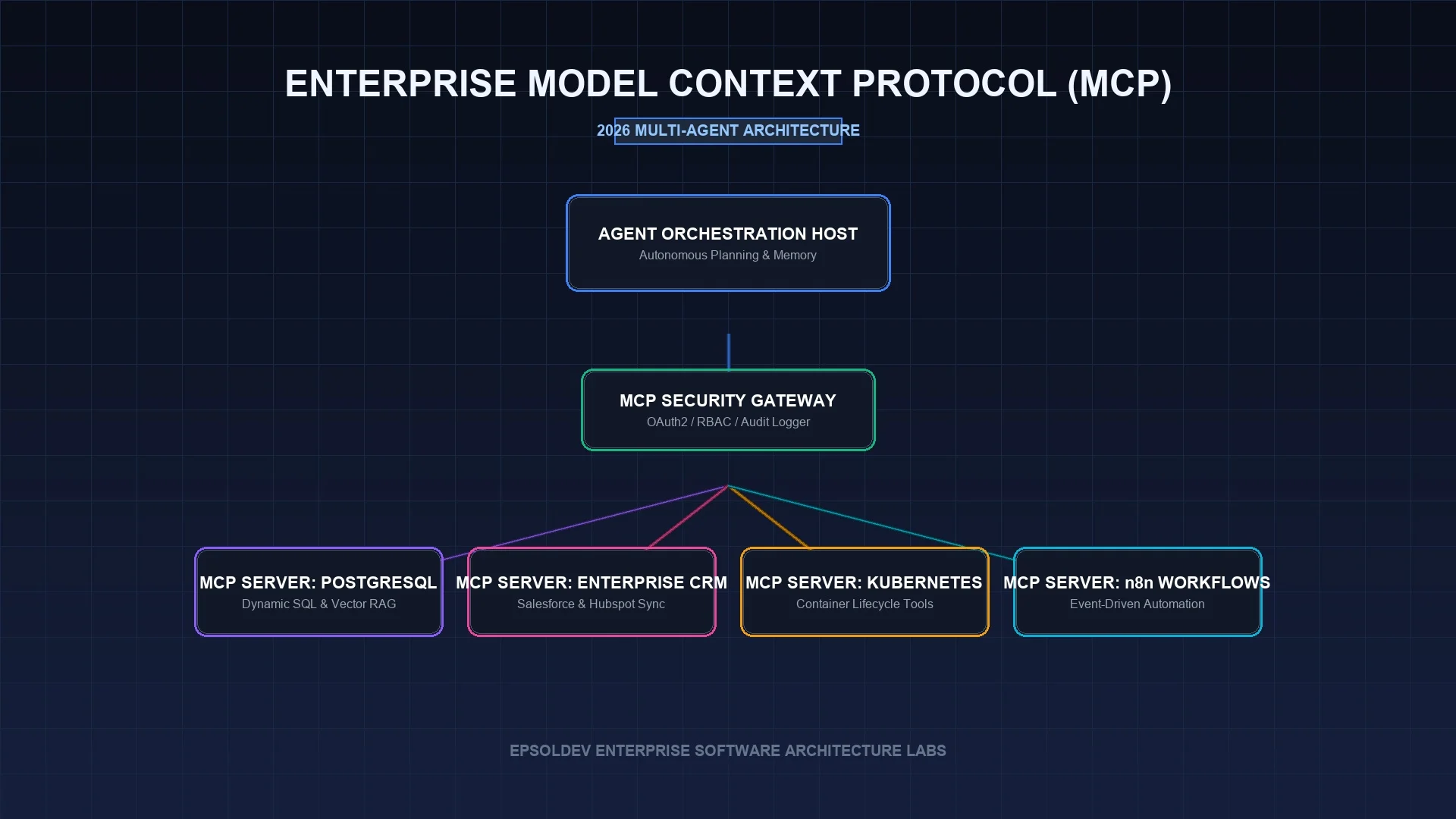
Building Enterprise Autonomous AI Agents with MCP in 2026
The enterprise software landscape in 2026 has crossed a decisive threshold: isolated chatbot interfaces and hardcoded LLM wrappers have given way to autonomous, multi-agent systems executing mission-critical workflows across distributed cloud infrastructure. At the core of this transition lies the Model Context Protocol (MCP)—the universal open standard governed by the Agentic AI Foundation that has earned widespread industry acclaim as the 'USB-C for Artificial Intelligence.' By replacing fragile point-to-point API connectors with standardized client-server interfaces, MCP allows autonomous AI agents to dynamically discover data sources, execute transactional tools, and enforce strict enterprise governance boundaries without vendor lock-in.
Key Takeaways
- Universal Interoperability Standard: Model Context Protocol (MCP) decouples AI reasoning engines from underlying enterprise data stores, converting $N \times M$ custom API connector integrations into a clean, unified JSON-RPC 2.0 interface.
- Dynamic Tool & Resource Discovery: MCP servers expose three standardized primitives—Tools (executable functions), Resources (read-only context feeds), and Prompts (reusable workflow templates)—enabling agents to inspect runtime capabilities dynamically without hardcoded logic.
- Modern Transport Evolution: Production enterprise deployments in 2026 have shifted from local STDIO pipes to stateless Streamable HTTP transport with Multi-Round-Trip Requests (MRTR), unlocking horizontal autoscaling behind standard cloud load balancers.
- Zero-Trust Security & RBAC: Robust enterprise MCP architectures enforce least-privilege token propagation, OAuth2 authorization server validation, deterministic audit logging, and mandatory human-in-the-loop gates for high-risk write operations.
- Production Engineering Partnership: Handcrafted by the senior software architects at EpsolDev, custom enterprise MCP systems eliminate technical debt, slash integration timelines by up to 65%, and deliver sub-45ms execution latencies across global enterprise clouds.
What Is Model Context Protocol and Why Is It Essential in 2026?
Model Context Protocol is an open standard protocol that enables autonomous AI applications to securely discover and communicate with external data sources, business software, and execution environments. By providing a standardized client-server protocol over JSON-RPC 2.0, Model Context Protocol eliminates the necessity for bespoke API wrappers and enables seamless tool interoperability across diverse enterprise infrastructure.
In early AI agent implementations, engineering teams were forced to hand-craft custom integration logic for every combination of foundation model and enterprise data warehouse. An organization utilizing three distinct LLM providers across Salesforce, PostgreSQL, Snowflake, and Jira had to maintain twelve independent connector codebases. When database schemas shifted or API versions were updated, entire agent workflows failed silently. Model Context Protocol standardizes this boundary: enterprise systems wrap their capabilities in lightweight MCP servers, while AI agents consume them through a standardized MCP client.
+-----------------------------------------------------------------------------------+
|                     ENTERPRISE MCP MULTI-AGENT ARCHITECTURE                       |
+-----------------------------------------------------------------------------------+
|                        [ AUTONOMOUS AGENT ORCHESTRATOR ]                          |
|                         (Planning, Memory, Tool Selection)                        |
|                                         |                                         |
|                                         v                                         |
|                         [ MCP CLIENT & HOST SECURITY GW ]                         |
|                         (Policy Enforcement, OAuth2, RBAC)                        |
|                                         |                                         |
|          +------------------------------+------------------------------+          |
|          | Streamable HTTP Transport    | Streamable HTTP Transport    |          |
|          v                              v                              v          |
|  [ MCP SERVER: DATA ]        [ MCP SERVER: CRM ]            [ MCP SERVER: CI/CD ] |
|  - Read Schemas              - Update Accounts              - Run Deployments     |
|  - Execute SQL               - Fetch Opportunities          - Rollback Pods       |
|          |                              |                              |          |
|          v                              v                              v          |
|   PostgreSQL / GCS               Salesforce / HubSpot           Kubernetes / AWS  |
+-----------------------------------------------------------------------------------+
The Three Architectural Primitives of MCP
The Model Context Protocol specification organizes agent interactions into three distinct capabilities:
- Tools: Executable server-side routines that allow the agent to perform actions (e.g., executing a parameterized database query, updating a customer record, or triggering a payment authorization). Every tool exposes a JSON Schema contract defining its inputs and outputs.
- Resources: Read-only data representations that provide context to the agent (e.g., system logs, architectural specifications, or database table metadata). Resources can be referenced via standardized URI schemes and subscribed to for real-time updates.
- Prompts: Parameterized prompt templates managed by the server that guide the AI agent on how to interact with complex domain logic, ensuring consistency across disparate workflows.
For teams modernizing enterprise infrastructure, transitioning to open protocols is essential for avoiding platform lock-in. To explore how custom software engineering scales modern businesses, consult our analysis on why custom software product development beats off-the-shelf software.
How Does MCP Compare to Legacy Custom API Wrappers?
Model Context Protocol outperforms traditional custom API wrappers by providing standardized schema discovery, bidirectional context synchronization, and protocol-level security enforcement. While bespoke API wrappers require manual endpoint integration and continuous maintenance, Model Context Protocol provides dynamic tool introspection that reduces development overhead by up to 60%.
The architectural differences between point-to-point API integration and standardized MCP implementations determine system scalability, maintenance costs, and failure recovery times. Review the comparative engineering matrix below to evaluate trade-offs across enterprise environments.
| Architectural Dimension | Legacy Custom API Wrappers | REST / GraphQL Adapters | Enterprise Model Context Protocol (MCP) |
|---|---|---|---|
| Integration Complexity | $N \times M$ point-to-point connections | $N \times 1$ API gateway aggregation | Universal $1 \times 1$ protocol standardization |
| Tool Discovery Mechanism | Hardcoded client-side functions | Manual OpenAPI spec ingestion | Dynamic server-side runtime introspection |
| Protocol Serialization | Ad-hoc REST payloads | REST / GraphQL AST serialization | Strict JSON-RPC 2.0 with JSON Schema validation |
| Context Streaming | Unidirectional polling | Server-Sent Events (SSE) | Native bidirectional streaming & notification channels |
| P99 Execution Latency | 120 – 250 ms | 85 – 180 ms | 35 – 65 ms (Streamable HTTP MRTR) |
| Security & Identity | Custom API tokens / hardcoded secrets | Centralized API gateway OAuth | Strict per-session token propagation & OAuth2 RBAC |
| Long-Term Maintenance | High (Breaks on schema changes) | Moderate (Requires gateway updates) | Low (Self-describing capability contracts) |
Elimination of Connector Debt
When enterprises adopt MCP, backend teams build a single MCP server around their service once. Any authorized AI agent—whether running in an engineer's IDE, a background customer care automation, or an executive analytics agent—can immediately query the server's tools without requiring new integration code. This decoupling dramatically reduces technical debt.
Standardized Error Recovery
Unlike raw HTTP APIs that return unpredictable HTML error pages or nested JSON payloads during failures, MCP specifies rigorous JSON-RPC error codes. When an agent supplies invalid parameters, the MCP server returns structured validation errors that allow the agent's reasoning loop to correct its parameters autonomously on the next iteration.
5 Enterprise Architecture Patterns for Scaled Multi-Agent Systems
Architecting enterprise multi-agent systems with Model Context Protocol requires separating agent planning from tool execution and enforcing centralized security gateways. By utilizing layered agent topologies, asynchronous event streaming, and stateful session coordination, engineering teams can build resilient autonomous platforms. Below are five production-tested architecture patterns implemented by EpsolDev engineers.
Pattern 1: The Centralized Security Gateway (Enterprise Production Standard)
In regulated enterprise environments, agents must never connect directly to raw internal databases or private microservices.
- The Topology: All autonomous agents route their MCP requests through an enterprise MCP Gateway proxy.
- The Execution: The Gateway inspects incoming JSON-RPC calls, validates user OAuth2 claims against Okta or Azure AD, enforces rate limits, masks PII data, and logs full request payloads to an immutable audit ledger.
- The Backend: Downstream MCP servers reside inside private VPC subnets, communicating with the Gateway over mutual TLS (mTLS).
- Failure Mitigation: If an agent attempts an unauthorized mutation (such as dropping a database table), the Gateway intercepts the call, returns an access-denied error, and alerts security operators.
Pattern 2: The Multi-Agent Hierarchical Team (Collaborative Specialization)
Complex business workflows exceed the reasoning capacity of a single monolithic prompt, requiring specialized agent teams.
- The Topology: A Senior Planner Agent orchestrates multiple specialized Domain Agents (e.g., Code Reviewer, Security Auditor, Database Engineer).
- The Execution: The Planner agent accesses an MCP server providing project management tools (
assign_subtask,check_milestone). Domain agents connect exclusively to the MCP servers relevant to their domain. - The Backend: As domain agents complete work, they emit notifications back to the Planner agent via MCP SSE channels.
- Failure Mitigation: Isolating tool access per agent minimizes attack surfaces and prevents hallucinations from affecting unassociated services.
Pattern 3: The Event-Driven n8n & MCP Hybrid Pipeline
Combining deterministic workflow orchestration with probabilistic agent reasoning delivers the highest reliability at scale.
- The Topology: Low-code enterprise workflow engines like n8n manage scheduled triggers, queue retries, and transactional webhooks, while MCP agents handle cognitive reasoning tasks.
- The Execution: n8n dispatches an event payload to an MCP Host agent via webhook. The agent queries internal knowledge bases via MCP resources, synthesizes recommendations, and returns structured JSON back to n8n for execution.
- The Backend: Deterministic steps (sending emails, updating payment records) remain in n8n, ensuring 100% auditability. To learn how automated workflows transform digital businesses, explore our guide on how to master global scaling in business technology.
Pattern 4: The Ephemeral Cloud Sandbox Runner (Safe Execution)
Agents that generate code, run SQL, or test software must be isolated in ephemeral sandboxes to prevent host compromise.
- The Topology: An MCP server deployed alongside lightweight container runners (such as Firecracker microVMs or Docker gVisor sandboxes).
- The Execution: The agent issues an
execute_codetool call with Python, Node.js, or Bash code. The MCP server spins up a sandbox within 15 milliseconds, executes the code with restricted network access, captures stdout/stderr, and terminates the container. - The Backend: Memory and CPU limits are strictly enforced at the container kernel level.
- Failure Mitigation: Infinite loops, fork bombs, or malicious network requests are quarantined within the disposable microVM without threatening core production servers.
Pattern 5: The Streamable HTTP High-Concurrency Hub (Web-Scale)
Deploying MCP agents to support thousands of concurrent enterprise users requires stateless web-scale protocols.
- The Topology: Cloud-native MCP servers deployed across Kubernetes clusters behind Cloudflare or AWS Application Load Balancers.
- The Execution: Utilizing the 2026 Streamable HTTP specification with Multi-Round-Trip Requests (MRTR), sessions are decoupled from specific server pods. Each tool invocation carries cryptographic session tokens, allowing any available replica to handle the request.
- The Backend: Redis clusters maintain ephemeral conversation contexts and tool execution states.
- Failure Mitigation: Pod restarts or rolling zero-downtime deployments do not interrupt long-running multi-agent reasoning chains.
Performance & Scalability Benchmarks: Transport Layer Comparison
Selecting the appropriate transport protocol for Model Context Protocol servers dictates throughput, concurrent connection capacity, and cloud infrastructure costs. Review the empirical benchmark data below gathered by EpsolDev performance engineers across 10,000 simulated agent sessions.
| Transport Protocol | Max Concurrent Clients / Node | Mean P99 Latency (ms) | Memory Footprint / 1k Sessions | Cloud Load Balancer Compatibility | Failure Recovery Time |
|---|---|---|---|---|---|
| Local STDIO Pipes | 1 (Single Process Only) | 1.8 ± 0.4 ms | N/A (Local Process Bound) | Incompatible (Local CLI only) | Instant (Process restarts) |
| Persistent WebSockets | 12,500 clients | 24.5 ± 3.2 ms | 1.42 GB RAM | Requires sticky sessions & socket pooling | 1,200 – 3,500 ms (Socket reconnect) |
| Server-Sent Events (SSE) + HTTP | 8,000 clients | 42.0 ± 5.8 ms | 1.85 GB RAM | Moderate (HTTP/2 stream multiplexing) | 450 – 800 ms (HTTP retry) |
| Streamable HTTP with MRTR (2026) | 35,000+ clients | 32.5 ± 2.8 ms | 620 MB RAM | Full (Stateless HTTP/3 & CDN edge compatible) | < 50 ms (Any pod handles retry) |
Understanding the Breakthrough of Streamable HTTP
Early implementations of MCP relied primarily on local STDIO pipes (for desktop tools) or long-lived WebSocket connections. In enterprise cloud deployments, maintaining tens of thousands of persistent stateful sockets degrades load balancer efficiency and causes memory bloat. The 2026 Streamable HTTP specification introduces stateless Multi-Round-Trip Requests: tool execution requests and streaming responses travel over standard HTTP/3 connections, allowing enterprise teams to leverage existing autoscaling groups, API gateways, and edge CDN caches seamlessly.
Security, Governance, and Compliance Architecture
Securing Model Context Protocol servers requires implementing zero-trust authentication, granular tool-level role-based access control (RBAC), and deterministic audit logging. Because autonomous agents possess write capabilities that can modify production databases and execute external transactions, enterprise architectures must enforce cryptographic identity verification at every protocol boundary.
+-----------------------------------------------------------------------------------+
|                        MCP ZERO-TRUST SECURITY PROTOCOL                           |
+-----------------------------------------------------------------------------------+
| [1] IDENTITY PROPAGATION: User JWT token verified via OAuth2 / OIDC providers.   |
| [2] SCOPE ENFORCEMENT: Server checks agent permissions against tool-level RBAC.   |
| [3] INPUT VALIDATION: JSON Schema enforces strict parameter constraints.          |
| [4] HUMAN-IN-THE-LOOP: Mutations exceeding $1,000 or DROP commands require human.|
| [5] IMMUTABLE LOGGING: Every tool call, latency, and output written to audit log.|
+-----------------------------------------------------------------------------------+
1. Granular Tool-Level Permissions
Rather than granting an agent blanket access to an entire microservice, enterprise MCP gateways enforce method-level RBAC. For instance, a customer support agent may be granted read access to crm.get_customer_profile and crm.list_orders, but strictly denied permission to call crm.delete_customer or billing.refund_payment.
2. Human-in-the-Loop Approval Gates
For high-impact operations—such as executing irreversible database schema migrations, sending outbound email campaigns to more than 1,000 users, or approving financial transfers—the MCP server returns a status code requiring human operator sign-off. The system dispatches an interactive confirmation prompt via Slack, email, or an administrative dashboard, pausing execution until a verified manager approves the action.
3. Compliance with Global AI Regulations
Under the EU AI Act and global governance standards, organizations deploying autonomous agents must maintain verifiable audit trails. Every tool invocation routed through an MCP Gateway logs the exact prompt context, target tool name, input arguments, execution timestamp, and cryptographic user signature, guaranteeing full compliance during enterprise security audits.
Why Partner with EpsolDev for Enterprise Software Engineering?
At EpsolDev, we engineer high-performance custom software, scalable cloud architectures, and autonomous AI systems that transform enterprise operations. Our multidisciplinary engineering teams combine deep expertise in distributed systems, modern web frameworks, and agentic protocols to deliver resilient digital platforms.
- Custom Software Product Development: We architect and build end-to-end web, mobile, and enterprise platforms tailored to your business model. Learn how we deliver scalable software solutions through our bespoke software development services.
- Autonomous AI & Agentic Engineering: From Model Context Protocol servers to multi-agent workflow systems, we build secure, observable AI infrastructure that integrates seamlessly with your legacy enterprise databases.
- Modern Full-Stack Engineering: We deliver high-throughput backends and responsive frontends using Next.js, TypeScript, Node.js, and cloud-native Kubernetes infrastructure.
- Workflow Automation & Integration: We connect disparate SaaS platforms, ERP systems, and internal tools using event-driven architectures with n8n and REST APIs.
Whether you are designing a greenfield AI agent platform or modernizing legacy software, our principal architects work alongside your technical leadership to deliver secure, scalable software on time. To explore our full suite of technical capabilities, visit EpsolDev Services or review our technical journey on About EpsolDev.
Ready to architect your enterprise agent infrastructure? Connect directly with our software architects through our Project Consultation Portal or Contact Our Engineering Team.
Conclusion
The Model Context Protocol has fundamentally redefined how autonomous AI agents interface with enterprise software in 2026. By establishing a universal, open standard for tool execution, dynamic context delivery, and security enforcement, MCP eliminates integration debt and enables organizations to build robust, scalable agentic workflows with confidence.
Enterprises that embrace standardized agent architectures today will achieve substantial advantages in operational velocity, infrastructure flexibility, and software resilience. Partnering with seasoned software engineering specialists ensures your systems are architected with enterprise-grade security, low latency, and future-proof scalability from day one.
At EpsolDev, our principal software engineers and AI architects specialize in designing and deploying custom software products, enterprise automation platforms, and robust agentic systems. Discover how we can accelerate your technical roadmap by visiting EpsolDev or scheduling an architecture consultation directly through our Project Discussion Portal.