

Investing in custom software development Australia is worth it for businesses and enterprises whose core operational workflows or customer-facing platforms outgrow off-the-shelf SaaS products. At EpsolDev, we engineer bespoke digital products that eliminate recurring per-seat licensing fees, integrate direct automation into day-to-day operations, and grant full ownership of the intellectual property from day one.
Key takeaways
- Custom software eliminates rigid licensing constraints by giving your business complete ownership of source code and data assets.
- Purpose-built web applications and mobile products align directly with proprietary workflows rather than forcing operational compromises.
- Built-in workflow automation and search-ready technical architectures ensure long-term commercial efficiency and customer acquisition.
- Flexible engagement frameworks allow organisations to scope functional milestones cleanly without operational bloat.
What this service covers
Our bespoke development services cover the entire engineering lifecycle, delivering purpose-built systems that support measurable business expansion. When you partner with us, we unify technical architecture, user experience, and ongoing business visibility under a single technical roadmap.
Custom software and web application development
We build custom software and high-performance web development solutions tailored to complex business logic. What this means for you is complete operational freedom: whether you require an internal resource planning platform, a customer management portal, or a scalable digital tool, your codebase reflects your business rules rather than the generic workflows imposed by commercial off-the-shelf software.
Mobile app development across native and cross-platform stacks
Our mobile app development practice delivers responsive, secure applications that connect your users on iOS and Android. By engineering resilient mobile endpoints, your organisation can serve field staff, enterprise clients, or consumers directly without friction, ensuring seamless synchronization across existing databases.
UI/UX design focused on operational usability
Through dedicated UI/UX design, our team translates complex workflows into intuitive digital interfaces. What this means in practice is reduced onboarding time for your internal teams, higher task-completion velocity, and lower user drop-off rates across mission-critical software portals.
Technical SEO services and workflow automation
Unlike conventional development setups that treat marketing and operations as afterthoughts, we embed SEO services and workflow automation directly into development. By coupling clean back-end architecture with search-ready structures and automated background triggers, your software serves as both an efficient engine for daily work and a scalable platform for customer acquisition.
| Service Pillar | Primary Business Focus | Key Architectural Deliverable |
|---|---|---|
| Custom Software | Bespoke back-office operations | Scalable enterprise architecture |
| Mobile Applications | Customer and field-team mobility | Native and cross-platform builds |
| Web Development | Client-facing digital tools | High-performance web applications |
| UI/UX Design | Product usability and conversion | User journey wireframes and design systems |
| Workflow Automation | Manual overhead reduction | Integrated programmatic triggers |
| SEO Services | Organic reach and visibility | Search-ready technical page foundations |
How the engagement works, step by step
A structured engagement model ensures your project moves from technical discovery to production deployment without loss of velocity or scope clarity. We guide businesses through systematic phases designed to validate requirements and maintain absolute transparency.
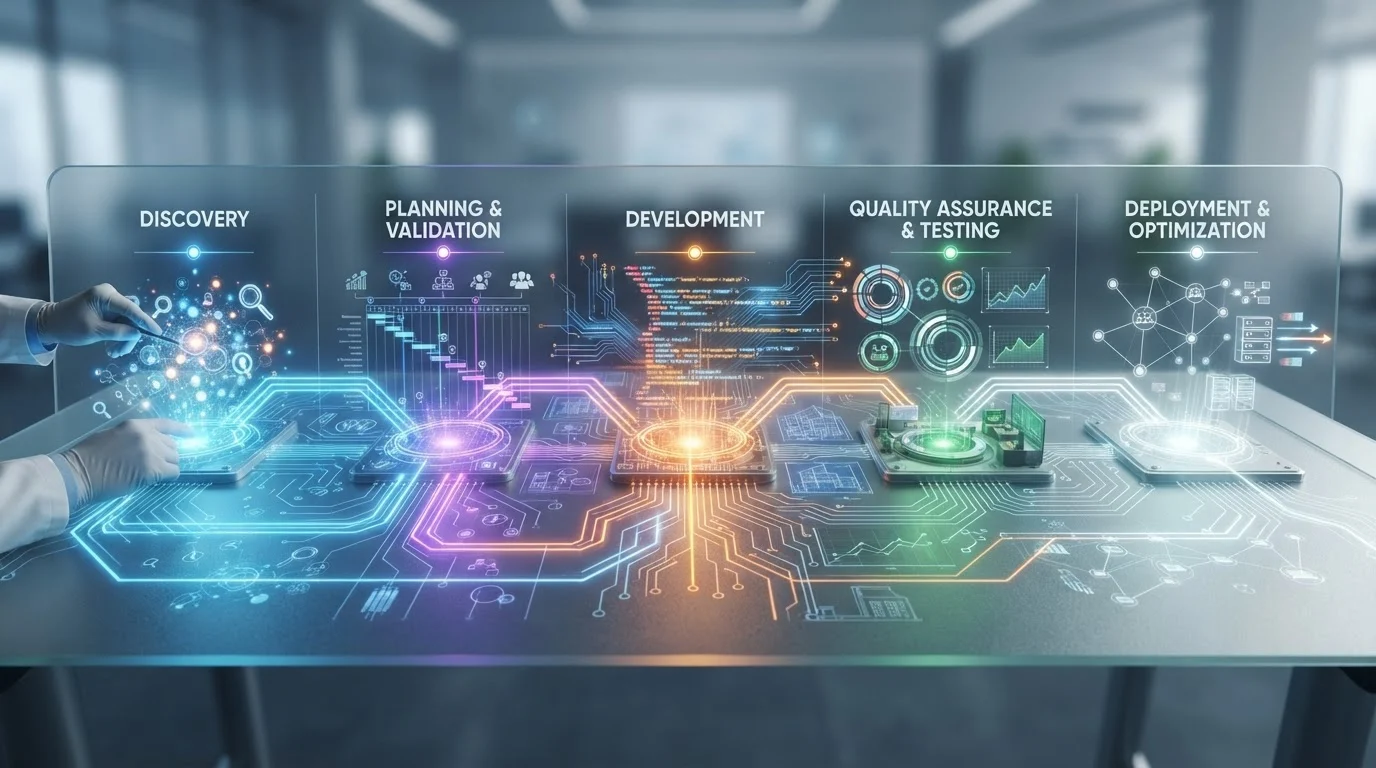
How the engagement works, step by step - Australia
Discovery and system architecture definition
Every build starts with technical discovery, where we audit operational requirements, integration endpoints, and user roles. For a deeper look at structured planning, explore our guide on 5 Custom Software Product Development Stages USA to see how systematic roadmapping mitigates functional risk early.
Interactive prototyping and visual engineering
Before writing production code, our UI/UX designers create wireframes and high-fidelity prototypes. This stage allows your leadership and operational teams to test navigation logic, review user journeys, and validate layouts before engineering resources are deployed.
Agile software engineering and automation integration
Our developers write clean, documented code backed by automated testing suites. During this build phase, we implement workflow automation hooks and database rules, ensuring that your enterprise processes operate automatically across your application ecosystem.
Production rollout, SEO validation, and system handover
Once QA audits are complete, we deploy the software to your chosen server environments. At the same time, we configure search foundations and complete full source code and asset handovers to your organization.
What it costs and how projects are scoped
Project pricing reflects the overall scope, functional complexity, and integration requirements of your software. Because every enterprise tool solves unique operational challenges, pricing is structured around defined deliverables rather than arbitrary pre-packaged tiers.
Functional scope versus pre-packaged SaaS costs
Off-the-shelf platforms initially appear inexpensive, but subscription costs scale rapidly as your team grows. Custom software requires an upfront capital investment that remains fixed regardless of how many employees or clients utilize the platform over time.
Variable drivers in software architecture
The total engineering cost is determined by factors such as user roles, third-party API integrations, data processing loads, and automation requirements. We scope each feature systematically, enabling your leadership to prioritize core functional capabilities for initial release phases.
| Engagement Model | Best Suited For | Scope and Delivery Structure |
|---|---|---|
| Milestone-Based Build | Discrete product launches | Fixed deliverables against strict project phases |
| Dedicated Engineering | Continuous enterprise roadmaps | Ongoing development with flexible technical scope |
| Phased Modernisation | Legacy system overhauls | Incremental system upgrades across key workflows |
Timelines and what drives them
Development timelines are directly tied to system complexity, architecture depth, and stakeholder review cadences. Understanding these variables allows your organization to plan product rollouts with realistic milestones.
Architectural scope and third-party data layers
A focused web tool with standard user permissions can launch significantly faster than an enterprise platform requiring multiple database connections, complex automation triggers, and mobile companion apps. Building bespoke integrations naturally requires rigorous interface testing to ensure reliable data consistency.
Asset delivery and review velocity
Timelines remain tightest when requirement sign-offs, organizational assets, and operational access credentials are provided on schedule. When technical discovery produces well-defined user stories early, production iterations proceed without mid-sprint pauses.
Production QA and edge-case testing
Ensuring stability across different browsers, mobile devices, and system loads requires dedicated testing cycles. Allocating appropriate time for QA prevents functional errors from reaching operational environments once live.
How to evaluate a provider
Selecting the right development partner requires evaluating engineering hygiene, full-stack capabilities, and communication maturity rather than surface-level promises. Working with an agency that serves international markets brings broad architectural experience to your local Australian operations.
Technical versatility across platforms
Your provider must possess the engineering skill to build across web, mobile, and automated backend layers. An agency that only understands front-end presentation cannot deliver the complex business logic or automated workflow integrations necessary for enterprise efficiency.
Direct intellectual property ownership
Always verify that your provider transfers complete ownership of all source code, technical assets, and database schemas upon delivery. At EpsolDev, your business retains full ownership of everything we engineer, ensuring you are never locked into proprietary agency ecosystems.
Growth-ready capabilities including technical SEO
Great software must be discovered by users and search engines alike. Choosing a partner that delivers both custom engineering and technical SEO services ensures your web platforms are built with optimized site structures, performance-first assets, and indexation-ready page architectures.
Communication, reporting and handover
Clear cross-border communication is essential when collaborating remotely with technical teams. We operate transparent management workflows that keep Australian stakeholders fully informed throughout every development cycle.
Regular milestone reporting and progress tracking
We provide regular development updates through dedicated tracking boards and project summaries. This visibility allows your team to review working code increments, test newly deployed staging features, and provide practical feedback efficiently.
Asynchronous and real-time coordination
Our operating presence on Asia/Karachi time allows our team to structure regular workflow overlaps with Australian business hours. Critical planning, project check-ins, and demonstrations occur smoothly while development tasks continue uninterrupted during focused engineering windows.
Comprehensive documentation and codebase handover
Upon launch, we provide documented source repositories, architectural maps, and administrative guides. For businesses considering advanced engineering roadmaps, our technical analysis of Building Enterprise Autonomous AI Agents with MCP in 2026 demonstrates our commitment to transparent, future-ready architecture.
Risks and how they are managed
Software projects introduce operational risks if scope, code maintainability, and infrastructure scaling are left unmonitored. We manage these risks proactively across each phase of development.
Managing scope creep through defined backlogs
Unchecked feature expansion can disrupt development timelines and budgets. We mitigate this by establishing a prioritised feature backlog during discovery, ensuring that any subsequent scope changes are evaluated transparently before development commences.
Code quality and automated validation
Unstable code creates technical debt that slows future product iteration. We apply strict version control, code review standards, and automated unit testing to verify that new builds do not compromise existing functionality.
Operational transition and deployment risks
Deploying a new enterprise platform can disrupt day-to-day operations if cutovers are mishandled. We deploy staged environments and run rigorous integration checks prior to DNS updates and final database cutovers, ensuring minimal downtime.
Common mistakes buyers make
Many organizations run into friction by approaching software development without sufficient architectural planning or long-term operational vision. Avoiding these common missteps preserves your engineering capital.
Choosing generic off-the-shelf software for specialized processes
Off-the-shelf software forces your staff to adapt their daily operations to third-party limitations. Over time, compounding subscription fees, paid add-ons, and inefficient workarounds cost significantly more than owning a bespoke system.
Neglecting search visibility during initial development
Rebuilding a completed web application to correct technical SEO deficiencies is costly and counterproductive. Web platforms must be engineered from day one with search indexing, schema markup, and performance metrics in mind.
Overlooking internal workflow automation
A custom software build that still requires manual data entry misses a massive operational opportunity. Embedding automation triggers directly within your application saves hundreds of administrative hours each quarter.
How to get started
Beginning your custom software development journey requires organizing your operational needs into clear business requirements before entering technical discovery.
Project preparation checklist
- Document your primary operational bottlenecks and current software limitations.
- Map out the essential user roles, permissions, and administrative workflows required.
- List any existing third-party systems, databases, or APIs that require technical integration.
- Identify your key operational metrics, such as time saved or platform conversion rates.
- Establish your internal review team and technical decision-makers.
Defining your baseline functional requirements
Start by focusing on the core functional capabilities that your platform must deliver on day one. By prioritizing must-have operational capabilities over secondary feature ideas, you ensure a faster deployment cycle and immediate business impact.
Contacting our development team
Once your primary objectives are outlined, connect with our technical team to discuss architecture, system requirements, and delivery milestones. We evaluate your business requirements and provide an actionable technical pathway forward.
Conclusion
Custom software development Australia is definitively worth it for organizations seeking complete control over their operational technology, user experience, and intellectual property. Businesses that invest in bespoke platforms eliminate ongoing subscription bloat and position their operations for long-term scalability and efficiency.
To build your next digital platform, get in touch with EpsolDev by phone at +92 3107923290 or email us at [email protected]. We deliver Custom Software Development, Mobile App Development, Web Development, UI/UX Design, SEO Services, and Workflow Automation for clients across the USA, Canada, Australia, Germany, and Japan. Visit our website at https://epsoldev.com or reach out to Get a Quote to schedule your initial consultation with our engineering team.