Facebook Publishing Pipeline
One platform, two upload protocols — a photo posts in a single call while a reel needs a three-phase resumable session, ordered so a reel failure never costs the post.
- Client
- EpsolDev
- Category
- Automation Engineering
- Completed
- 2026-08-15
- Built with
- n8n, Google Vertex AI, REST API
- Topics
- API Development, Automation
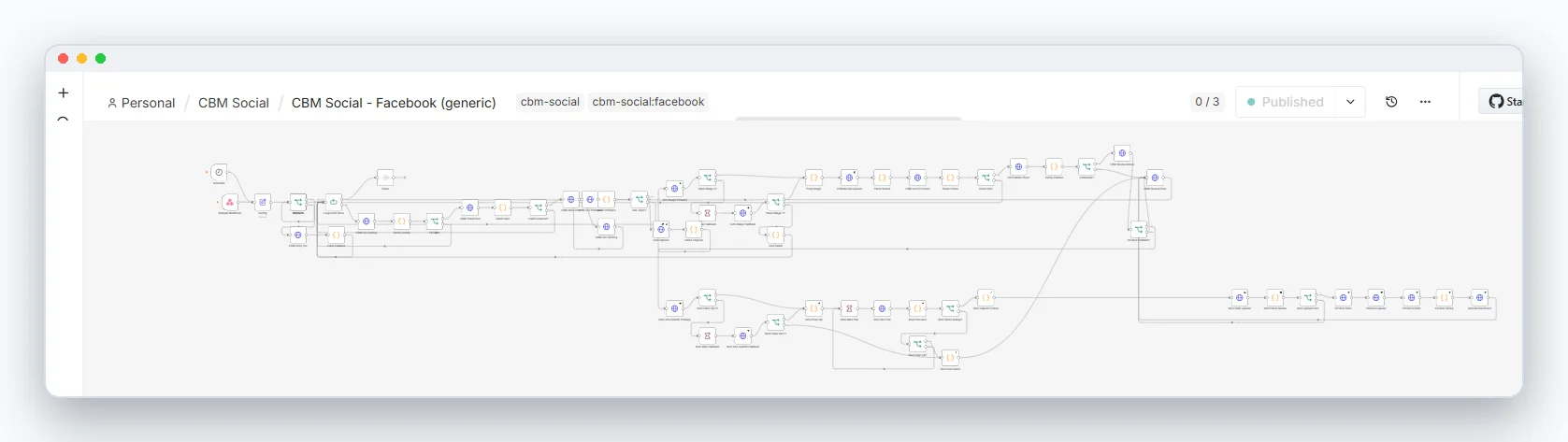
n8n 61 nodes Two protocols, one platform Publishing daily
Facebook is the clearest illustration of why these five pipelines could not be collapsed into one: the same platform uses two completely different upload protocols depending on whether you are posting a photo or a reel.
Part of the Social Distribution Network.
The photo path is one call
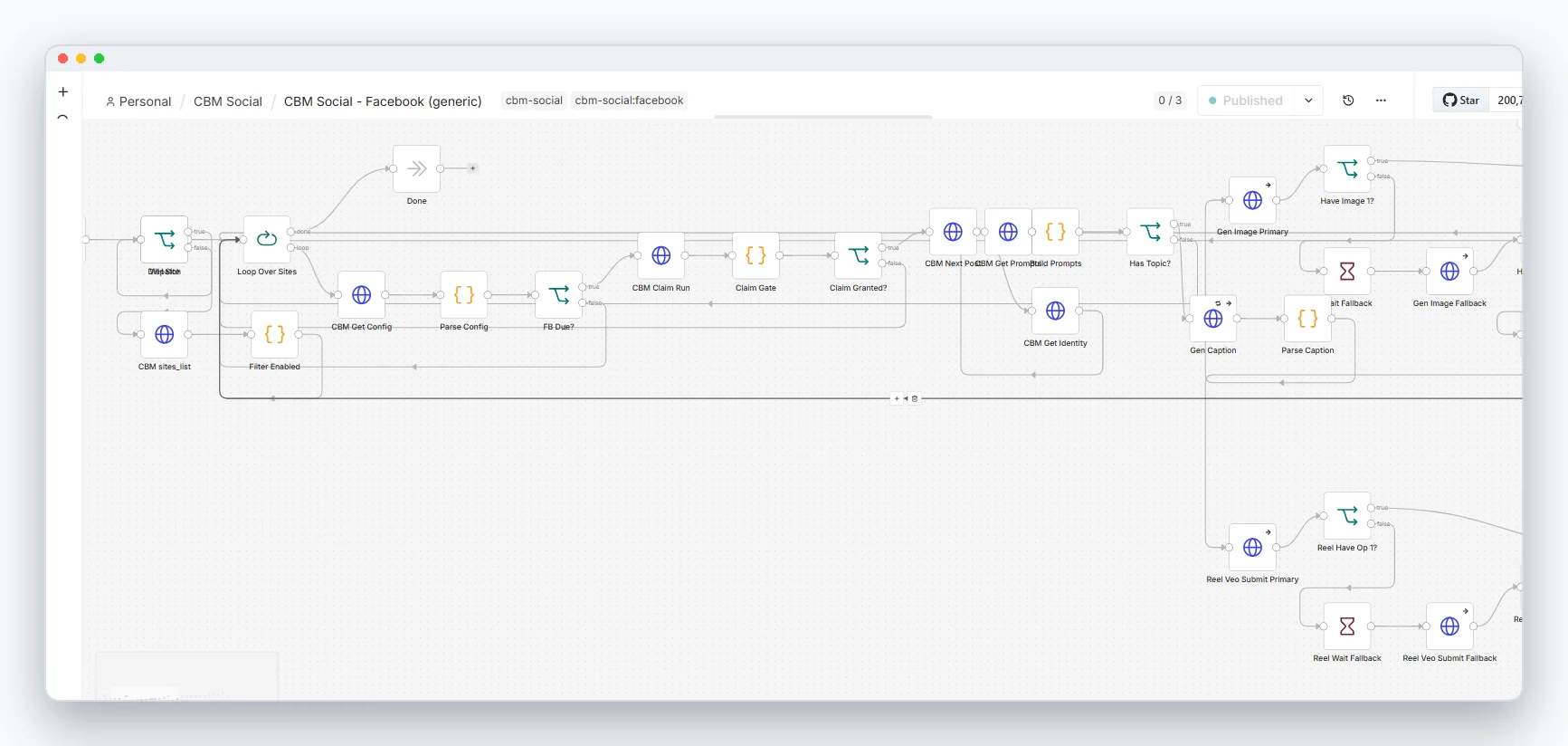
After the shared front half — dispatch, site loop, FB Due?, claim gate — the photo path is the simplest publish in the entire set:
Prep Image -> CBM Media Upload -> Parse Media -> CBM Get FB Creds
                                                       │
                                              Creds OK? -> FB Publish Photo
                                                                  │
                                                          Verify Publish -> Published?
One request. No container to create, no status to poll, no promotion step. Compare that with Instagram, where the same outcome needs create-container, wait, publish and verify.
The image still round-trips through the content platform's media library, because the Graph API wants a fetchable URL rather than bytes — and CBM Media Delete removes it the moment the post is confirmed.
The reel path is a three-phase upload session
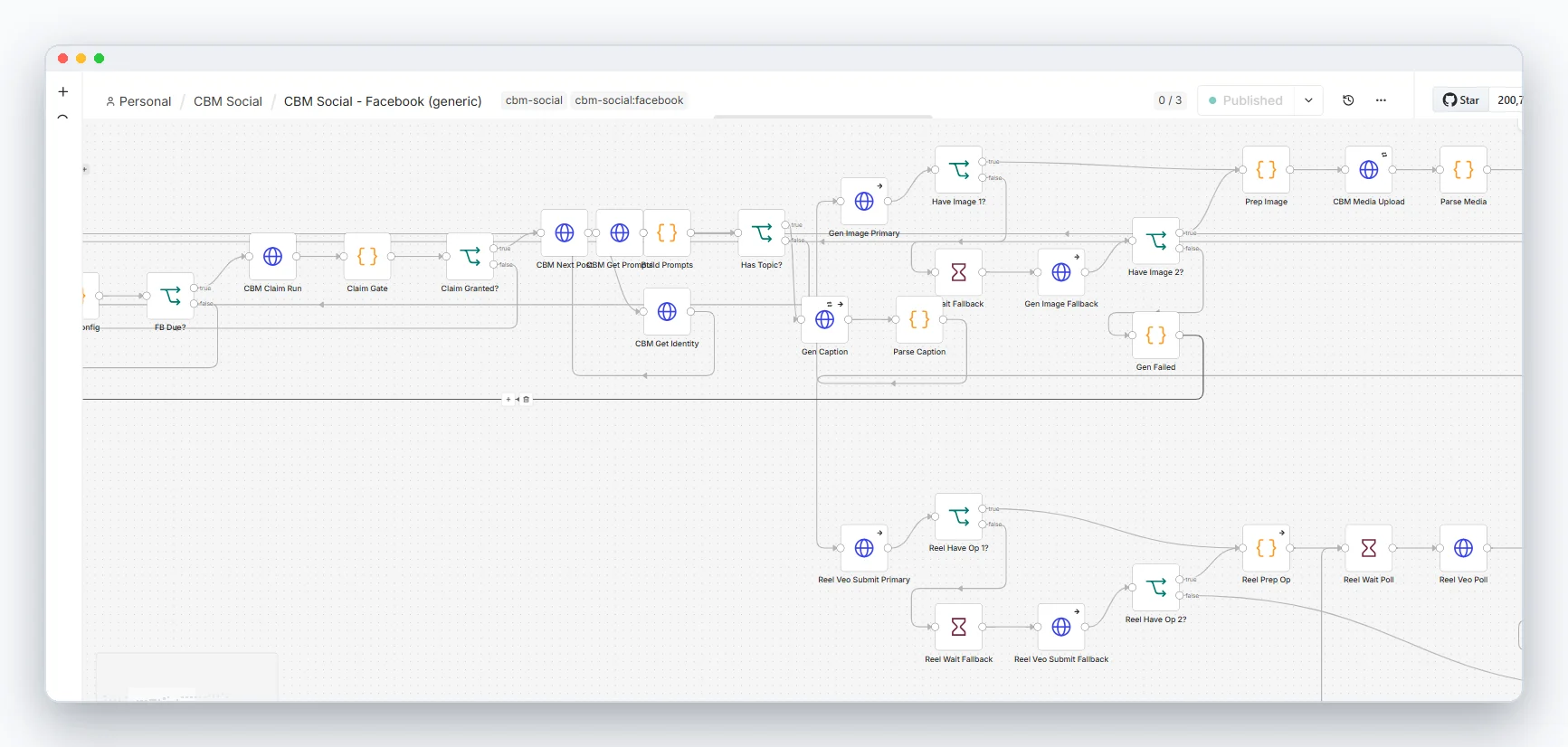
Reels do not go through the photo endpoint at all. They use a resumable upload session, which is three ordered calls that must all succeed:
FB Reel Start   ->  open a session, get an upload target
FB Reel Upload  ->  send the video bytes
FB Reel Finish  ->  close the session and publish
                        │
                  FB Reel Verify -> Reel Media Delete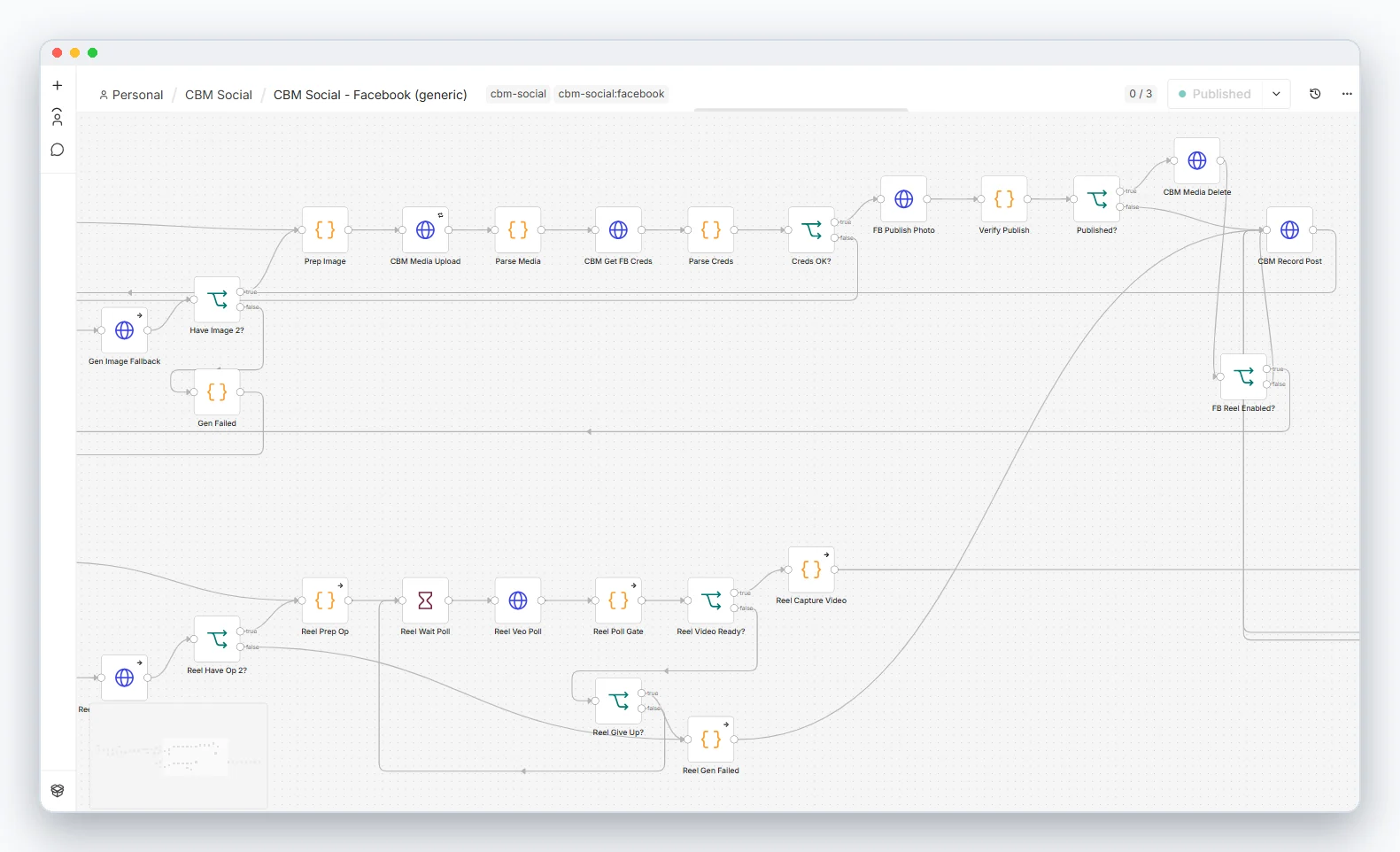
Before any of that, the video has to exist — which is its own asynchronous wait:
Reel Veo Submit Primary → Reel Have Op 1? → (fallback submit) → Reel Prep Op → Reel Wait Poll → Reel Veo Poll → Reel Poll Gate → Reel Video Ready?, with Reel Give Up? as the escape hatch.
Two protocols means two failure vocabularies A photo either posts or it does not. A reel can fail at generation, at session start, mid-bytes, or at finish — and each of those needs its own exit that still reaches CBM Record Post. Folding both into one generic "publish" step would have meant a switch node wrapping every stage.
Ordering: photo first, reel second
CBM Media Delete → FB Reel Enabled? — the reel branch only starts after the photo has published and its asset has been cleaned up.
That ordering is deliberate. The photo is the cheap, reliable output; the reel is the expensive, flaky one. Doing them in that order means a reel failure never costs you the post you were always going to get. The reliable output is never held hostage by the optional one.
Everything else is shared
Per-site scheduling through FB Due?, the claim gate against double-posting, primary-and-fallback generation on both caption and image, credentials fetched per run from the control plane, and a single CBM Record Post that every terminal branch reaches — success or miss.
Stack
n8n Facebook Graph API Google Vertex AI Imagen Veo JavaScript REST API