YouTube Publishing Pipeline
The only pipeline with no image stage — the generated video is the post, published through a per-run OAuth token exchange and a resumable byte upload.
- Client
- EpsolDev
- Category
- Automation Engineering
- Completed
- 2026-08-15
- Built with
- n8n, Google Vertex AI, REST API
- Topics
- API Development, Automation
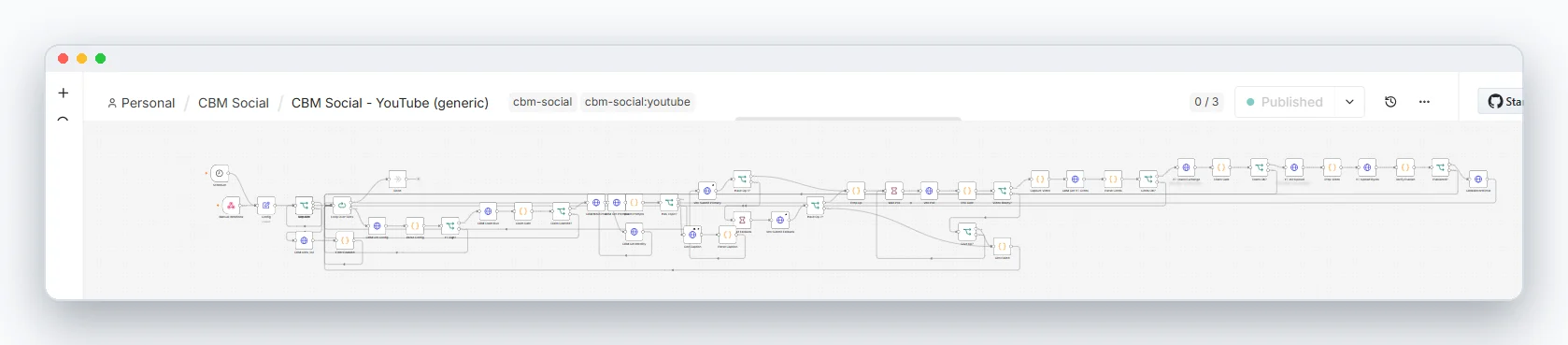
n8n 47 nodes Video-only Publishing daily
The odd one out. Every other pipeline in the set generates an image and treats video as an optional extra. Here the video is the post — there is no image generation node anywhere in the graph.
Part of the Social Distribution Network.
Straight from caption to video
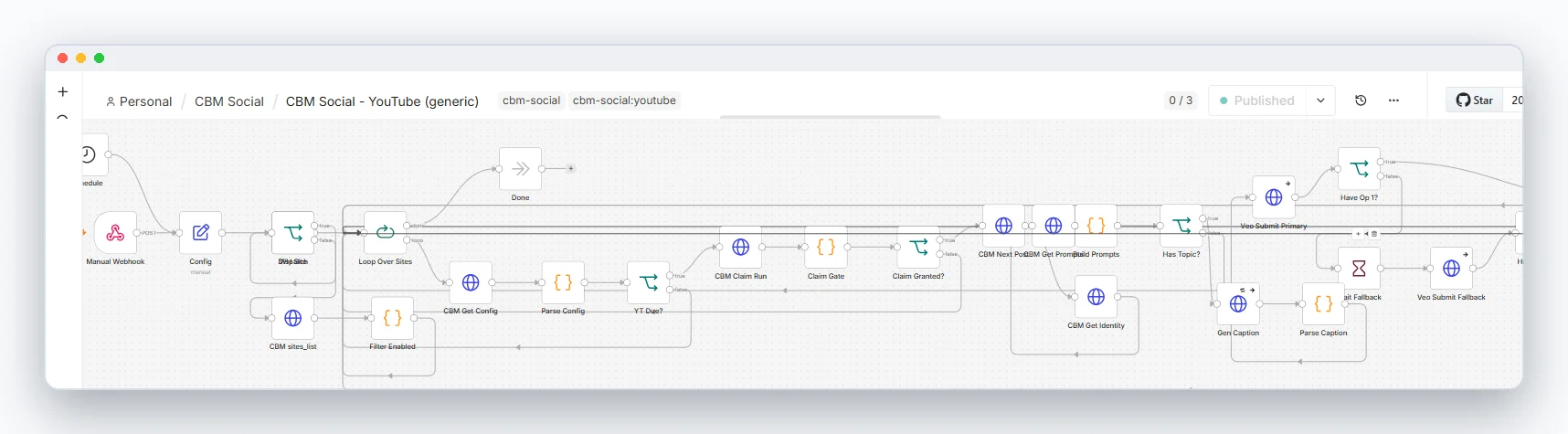
The shared front half is identical to the others — dispatch, Loop Over Sites, YT Due?, claim gate, CBM Next Post → CBM Get Identity → CBM Get Prompts → Build Prompts.
Then it diverges immediately:
Has Topic? -> Gen Caption -> Parse Caption -> Veo Submit Primary
                                                     │
                                             ( no image path exists )
The caption becomes the title and description. Everything else is the video.
One generative service, one polling loop
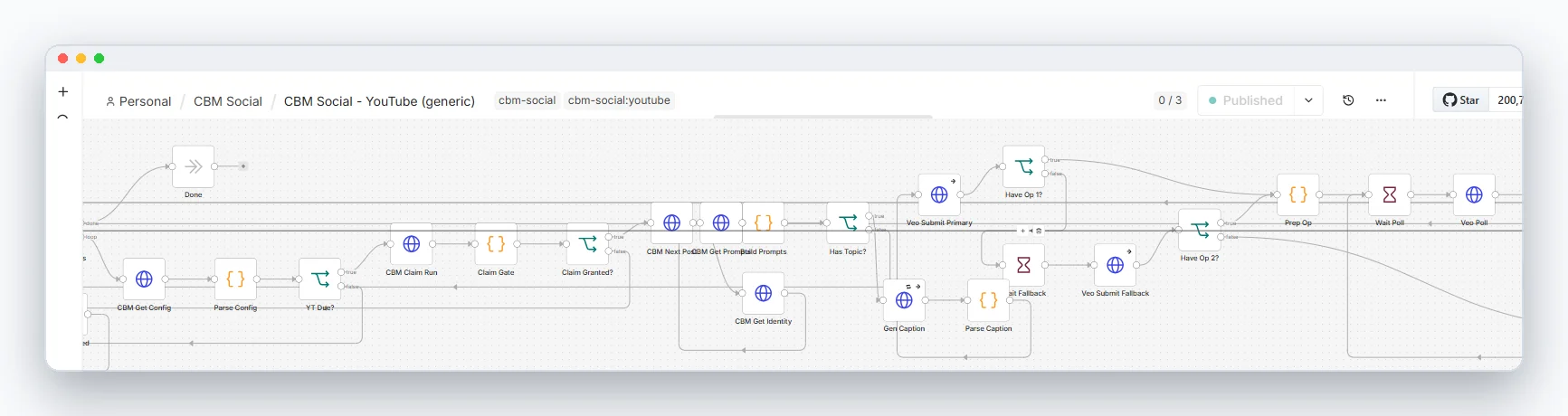
Video generation is asynchronous — you submit and receive an operation handle, not a file. So the graph submits, falls back if the submit failed, and then polls:
Veo Submit Primary -> Have Op 1? ─┬─ yes ─> Prep Op
                                  └─ no  ─> Wait Fallback -> Veo Submit Fallback
                                                                     │
                                                             Have Op 2? ─┬─ yes ─> Prep Op
                                                                         └─ no  ─> Gen Failed

Prep Op -> Wait Poll -> Veo Poll -> Poll Gate -> Video Ready?
               ^                                   │      │
               └───── no ─── Give Up? ─────────────┘      yes -> Capture Video
Give Up? is what keeps this bounded. Without it a stuck generation would hold an execution slot indefinitely.
The only pipeline that exchanges a token
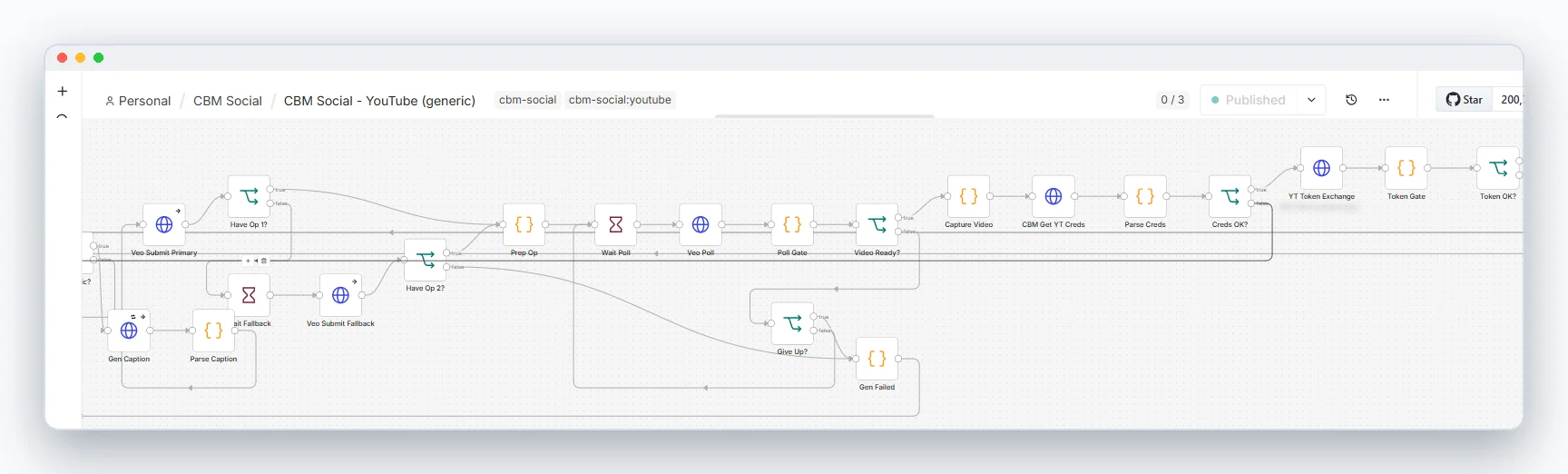
Instagram and Facebook accept a long-lived token directly. YouTube does not — it needs a short-lived access token minted from a stored refresh token on every run:
CBM Get YT Creds -> Parse Creds -> Creds OK?
                                       │
                                  YT Token Exchange -> Token Gate -> Token OK?
Token Gate and Token OK? exist because a refresh token can be revoked between runs. A revoked token exits to the site loop; it never reaches the upload. Discovering that after pushing a video's bytes would waste the most expensive thing the workflow produces.
A resumable upload, not a form post
Video bytes are too large for a single request, so YouTube uses a two-phase protocol:
YT Init Upload— declare the metadata, receive an upload targetPrep Video— shape the bytes for that targetYT Upload Bytes— send themVerify Publish→Published?— confirm the video exists before recording it
No media round-trip through the content platform. Unlike the image pipelines, nothing is uploaded to the library and nothing needs deleting — the bytes go from the generator straight to YouTube.
Why it earns its own graph
Same skeleton, four genuine divergences: no image stage, a token exchange, a resumable upload, and a caption that serves as title and description rather than a body. Merging this into the image pipelines would have meant branching around every one of those.
Stack
n8n YouTube Data API OAuth 2.0 Google Vertex AI Veo JavaScript REST API